Fall

Paper Bag Gnarly Trees


The other night at the Pumpkin Carving Party, my SIL Jennifer, was telling me about these paper bag trees she made with her Brownies. I must have looked like I was lost in the muck and mire because she finally said, "Geeze... just get me a paper bag and I can show you in 5 minutes." Well, she was true to her word. In a matter of minutes not only did she make a gnarly looking paper bag tree, but I felt confident that I could make one, too.

I sat down tonight to try to make one. Sure enough, in a matter of minutes, I made a tree. Out popped the camera, and easy peasy... a tutorial. I love it when things are this easy, although it would be a lot easier if all of you were sitting around my dining room table. We'd have a forest in a matter of minutes!

Basically, you can't make these wrong, and it is a craft you can do with children. So, go grab a few brown paper bags and pair of scissors, and you'll be making trees in no time. BTW... for the observant... you'll notice some blood smudges on the trunks and branches. Took a little nip out of my thumb :( But I didn't let a little cut stop me, trooper that I am ;) Ready? Here we go!

Measure up 4" from the bottom of the bag.

Cut down the center of the 4 sides of the bag to the 4" mark.

Twist the bag, then untwist.

Twist the trunk up 4" to the cut.

Each of the four sections will become a major branch of the tree.

Twist the first branch about halfway up.

Then, cut lengthwise down the bag to where the branch is twisted. You can make 1 or 2 cuts making 2 or 3 sections.

Twist each section. You can twist all the way up, or go halfway and make another cut. Continue cutting and twisting until all pieces of the 1st branch are all twisted.

Do the same for the other 3 branches. Make each one slightly different.

Make 4 or 5 snips at the bottom of the tree. Twist each section to create roots.

That's it. You can dink with the branches a bit until you are satisfied with the way they look. Then, tah dah... you are done and ready to make another. Now wasn't that the fastest and neatest craft you ever made? Thank you, Jenny, for teaching me this fun technique!


Links to the other Wee Folk Art crafts pictured in these photos:
Paper Clay Leaves can be found HERE.
Mini Pumpkins can be found HERE.
Campfire can be found HERE.

http://www.weefolkart.com
Copyright © Wee Folk Art 2008 - 2009. All rights reserved.

All photos, text and patterns are copyright protected. You may not copy, reproduce or redistribute any material found on WeeFolkArt.com without written permission. Wee Folk Art retains all rights.

Paperclay Leaves - Part 2

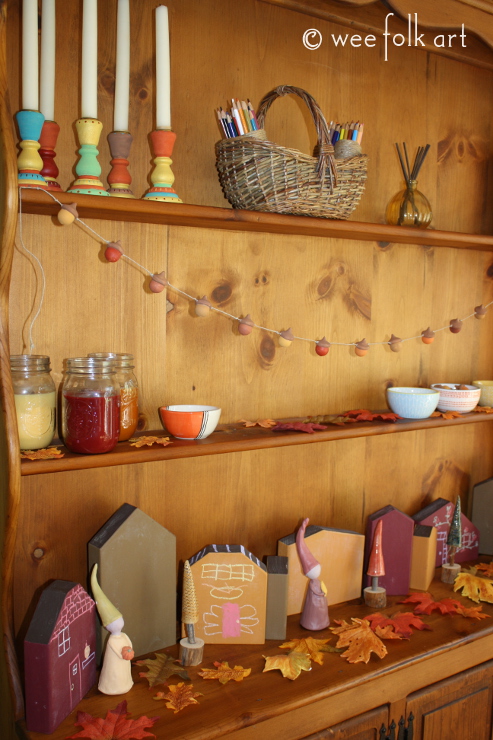
Last week I shared Paperclay Leaves - Part 1. Today, we are going to finish the project by painting and sealing the leaves. After that, you'll just have to decide where they should fall! I made 12 leaves, and put them on my Harvest Cupboard. They look so beautiful I want to make more for here and there around the house. Also, I want to make some with the wee ones. I can only imagine how beautiful theirs will be!

To begin with, I collected all the supplies I would be needing. Although you can use any paint on these, I wanted a translucent quality to the colors, so I used my Stockmar Watercolor Paints.

To replicate the coloring of the autumn leaves, head outdoors and collect a handful. Unfortunately, a number of our trees haven't turned yet, so I collect some photos online and printed them for a reference.

I began by using a very thinned yellow "whitewash". I covered the front and back.

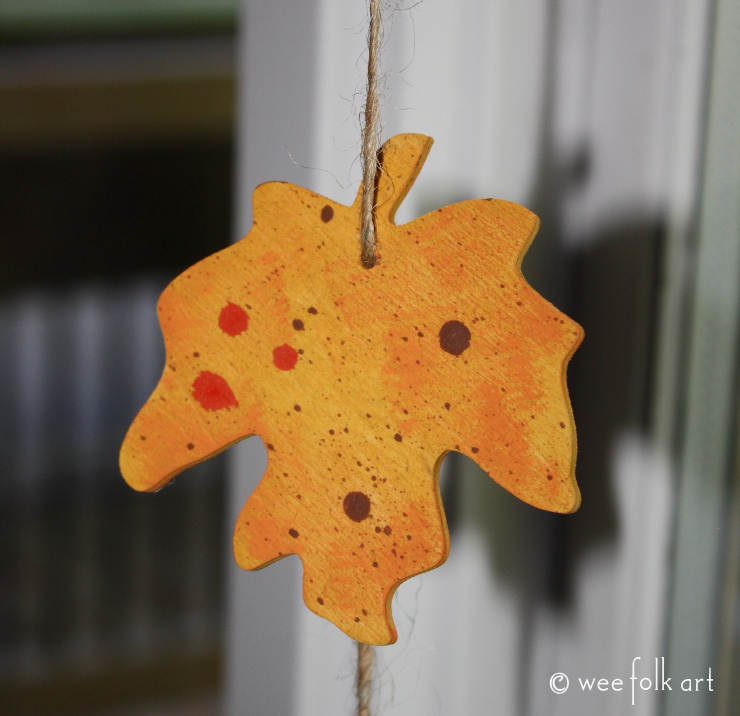
Then, I started adding other colors, mimicking the photos of leaves, but mostly just putting colors together in a pleasing fashion. I started by adding watered down colors, working my way up to deeper tones. I tried to varying the colors on each leaf. Then, I let the leaves dried and finally used a "dry brush" method to add accents. To dry brush, use your watercolors full strengths, dabbing your brush on a cloth before starting, then brush very small amounts of paint on the leaf for shading. Finally, I turned my brush over and adding dots here and there on some leaves to show imperfections.

Finally, I used Liquitex Gloss Medium and Varnish from Dick Blick as a sealer, but you could also use a product like Mod Podge.

When the leaves are dried, add them to your seasonal decorations.

NOTE: Although all the materials I used are non-toxic, these aren't meant to be played with. The clay is thin and can break if over handled. Of course they are plenty sturdy to have the wee ones help you decorate with them.  

Paperclay Leaves - Part 1

While looking for a clay project, I came upon this lesson plan for autumn leaves at Dick Blick. I was very excited and order 2 - 16 oz. packages of Creative Paperclay. The clay has a natural white color, air dries, can be painted, and is non-toxic and acid free. Something that the wee ones can use with supervision.

Before beginning, collect some leaves. You need to pick leaves that have well defined veins, so it will be visible on the clay. Also, you need leaves that are supple. Dried leaves, even along the edge, will crumble when you need to push them into the clay. I chose green leaves for impressions, and will collect colored leaves to study before painting.

Before using, I scored the paperclay into 16 pieces, since each leaf is suppose to use about 1 oz. of clay, depending on the size of the leaf. I then cut 1 piece all the way through and immediately placed the rest in a Ziplock.

I flatted the clay in my hands, then placed between 2 pieces of waxed paper and rolled like you would a pie crust.

Place a leaf, back side down, on your clay. Using your fingertips, press the leaf into the clay so the veins on the leaf leave marks in the clay.

Using a small paring knife, cut around the leaf, removing the extra clay.

Remove the leaf. The clay has been imprinted with the leaf and is ready to dry. It will take 1 - 3 days to dry depending on how thick you clay is and humidity.

If you would like to hang your leaves, either as pendants or perhaps as a garland, make a hole in the clay where you would like an opening to be. You must do this now, before the clay hardens.

Also, if you would like your leaf to have a more natural look, instead of being perfectly flat, set the leaf over another object to dry. I place mine on a small bowl, leafing the waxed paper under it. If you do this, be careful that you do not set the leaf on something that has ridges. While the clay is still wet, it could take on the impress of the ridges and dry that way.

NOTE: The tutorial on line suggests you lay the leaf on the table, face down, and press the clay on the back of the leaf, spreading the clay to recreate the natural edges. If doing this project with children, I suggest you use that method, then you will not need to cut away the extra clay. I tried it both ways, and found cutting the leaf out with a knife gave a more pleasing result, but it can be down either way.

We will be painting our leaves after they have dried.

For Paperclay Leaves - Part 2 click HERE.

Reposting of our Handprint Sand Candles


We are on our way to our favorite apple orchard for a wagon ride, apple picking, and, of course, delicious cider and hot donuts. YUM! There is also a wonderful petting zoo and barnyard play area. Bug, Fairy and Pixie are looking forward to sharing the experience with Little Lady.

While we are off doing that, we wanted to repost a favorite activity to do with the wee ones. Although it is not specifically an autumn craft, we find the finished product makes a lovely addition to our fall/Halloween decorations. Check out our Handprint Sand Candles HERE. Enjoy!

Girl Raffia Doll

The adage "necessity is the mother of invention" is never as obvious as when a parent is trying to fashion a toy for a child when traditional toys are unavailable. A hankie becomes a "pew doll", a piece of paper becomes an airplane or a "cooty catcher", and a handful of vines or flowers can be braided into a crown. Children are very good at creating their own toys, too. I read an article that said that most popular outside toy for a child is a STICK. Yep, just your garden variety, backyard stick. Think of the possibilities!

At one time, toys were a luxury to most children. Because of that, resourceful parents made toys from discarded items or items found in nature. Corn husks, straw and other plant fibers were often the basis for toys. Bits of fabric scraps and wood pieces were saved and fashioned into toys. Following that tradition, our dolls are made from raffia, which comes from the raffia palm, indigenous to Africa. Because raffia has very long fibers, it lends itself well to make dolls very similar to the yarn dolls we shared last year. I pulled fabric from my wee pieces stash bin. Although we are sharing our how-to, this is a very "ish" project. Follow our general directions, but delight in the fact that each and every doll will be unique.

Materials:
raffia
embroidery floss
calico scraps
large embroidery needle

Take raffia out of its wrapper and hang.

Find a lid or book for wrapping the height of the doll you wish to make. You can also cut a piece of cardboard to size. Mine is 7 1/2"

Cut off several strands of raffia, and holding it at the bottom of your lid, wrap the raffia around the lid. IMPORTANT: your ends must start and stop at the bottom of your lid. Continue wrapping strands until you are happy with the size.

Slip a thick piece of raffia under all the raffia loops at the top and tie tight and securely. This will be the top of the head. Leave the ends for now.


Using another piece of raffia, create the neck by wrapping raffia around the neck several times. Tie off the neck tight and secure. This should be about 1 1/2" from the top of the head. Thread one end of the raffia tie through a needle, and weave the ends through the neck a couple of times, and clip close to the neck.


Clip the bottom loops of the raffia.

To make the arms, again wrap raffia around your lid. The arms should be about half as thick as the body. Tie off the raffia about 1 1/2" from the bottom of the lid, and then cut through the loops at the bottom. This will give you a long rope of raffia, tied at one end.

Tape the tied end to a work surface, and braid the raffia. You will want your arms to be about 7 1/2". I find it easiest to braid farther, then tie off the end at 6 1/2" and cut through the braid at 7 1/2".


DON'T throw away your scraps! Simply take the raffia you cut off, secure it in the middle, weaving in the ends, and you have a corn stalk bundle! Also, save your little scraps. You can use these in other projects... you never know!


Separate the raffia on the body in two. Slip the braided arms between the divided raffia, and push up toward the neck. Now, tie off the waist like you did the neck.


At this point, weave in the ends on top of the head. (Not pictured.)

Any number of materials can be used for hair: dyed raffia, corn silk, yarn, etc. Staring at the forehead, tack on small amounts of hair using 6 strands of matching floss. (About 9" long.) Keep adding more strands around a center part until you get to the middle of the back of the head. Tie off. You can now "style" the dolls hair into a low ponytail, braids, a nape bun, or leave it flowing. I tied off mine to make a low ponytail. NOTE: If you would like a bun high on the head, tack on hair around the hairline instead of down the middle.


Using 6 strands of floss, add eyes and a mouth. I used straight stitches for the eyes. For the mouth, I used straight stitches, then wrapped the straight stitches several times. Your starting and finishing knots can be hidden on the back of the head.


If the bottom of the doll is uneven, clip the bottom a little to even it out. (Not pictured)

To make the bodice, ripe a piece of fabric 1" by about 15". (You can learn about ripping fabric HERE.)

Lay the piece behind the doll's neck. The wrong side of the fabric should be against the doll. Crisscross the fabric over the doll's chest. Turn the doll over and tie the ends. Clip off the extra fabric, by cutting on an angle or in Vs. 


To determine the size of the skirt, measure from the waist to the bottom of the doll. SUBTRACT 1". This will be the length. For the width, add about 3". (Remember, this is an "ish" thing :) Rip a rectangle of fabric to these measurements.

Along one long side of the fabric rectangle, sew a running stitch using 6 strands of floss. (Not pictured.) Gather the fabric around the waist and tie off securely. You can either work the ends in, or tie in a bow.


Tah dah... done :) Make one or make a whole village. I will share the directions for the boy later in the week.


http://www.weefolkart.com
Copyright © Wee Folk Art 2008 - 2011. All rights reserved.


All photos, text and patterns are copyright protected. You may not copy, reproduce or redistribute any material found on WeeFolkArt.com without written permission. Wee Folk Art retains all rights.


Syndicate content